Bonus Buy & Feature Buy Rules: Why They’re Often Restricted
March 14, 2026
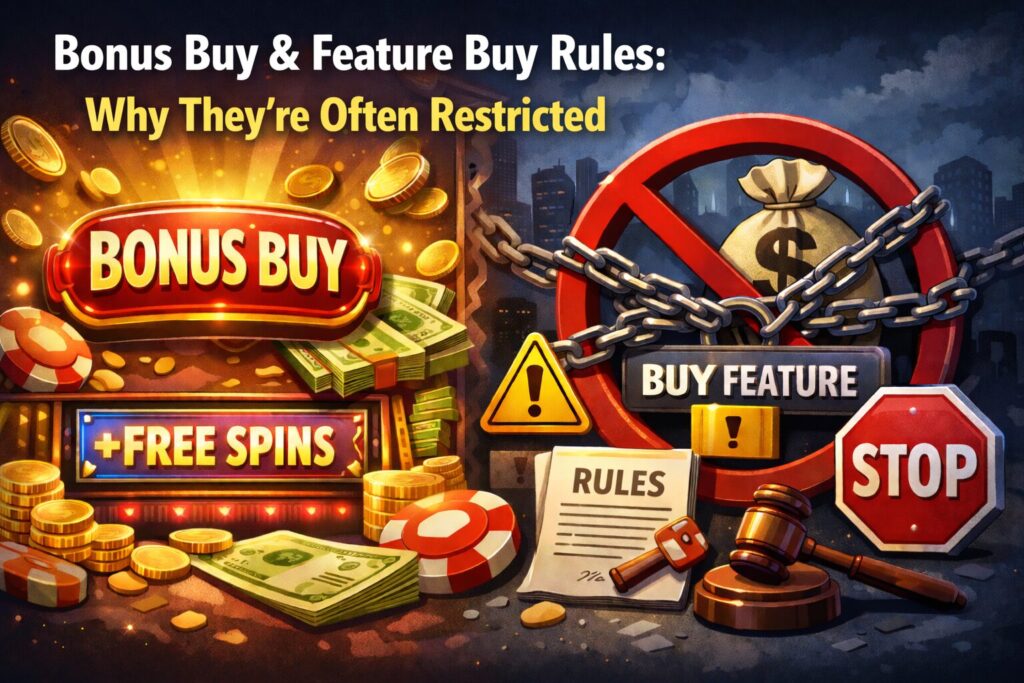
Bonus Buy and Feature Buy mechanics can be fun in cash play, but they are one of the easiest ways to break bonus terms without realizing it. In many casinos, the problem is not the feature itself — it is how that feature interacts with max bet limits, excluded games, game contribution, and “irregular play” clauses. If you ever plan to claim a casino bonus, this is one of the rulesets worth understanding before you place a single spin.
Contents
- What Bonus Buy and Feature Buy actually mean
- Why casinos often restrict them
- How bonus terms usually handle them
- What usually counts as a violation
- Realistic examples
- Checklist before you use one
- What to do if you already used one
- FAQ
What Bonus Buy and Feature Buy actually mean
In most modern slot terminology, Bonus Buy or Feature Buy means paying an extra amount to enter a bonus round directly instead of waiting for it to trigger naturally. In practice, the game may let you buy free spins, a special bonus mode, a collector feature, or another premium round for a multiple of your current stake.
That sounds simple, but there is an important distinction: a Bonus Buy does not give you a special legal exemption from the bonus terms on your account. If you have an active promotion, the casino usually evaluates that purchase through the same filters as any other bet: max stake rules, eligible games, excluded features, game weighting, and campaign-specific restrictions.
It is also worth separating the product from the marketing word “bonus.” A bonus buy inside a slot is a game mechanic. A casino bonus is a promotion attached to your balance. The reason players run into trouble is that those two systems do not always mix well.
Why casinos often restrict them
1) They can break max bet rules instantly. This is the most common issue. Many casinos treat the full purchase price of the feature as the real wager. So if a game is set to €1 stake and the feature costs 80x, the operator may treat that action as an €80 bet — not a €1 spin. If your active bonus has a €5 max bet rule, you can breach it in one click. For a detailed breakdown of that logic, see our guide to max bet rules.
2) They compress volatility and speed up wagering. Promotions are priced around expected gameplay patterns. Buying directly into a feature changes the pace of play and may concentrate variance into fewer, much larger decisions. From an operator perspective, that can make a promotion easier to exploit or at least harder to model consistently.
3) They often overlap with excluded-game logic. Some casinos allow only slots at 100% contribution, while table games, live casino, jackpot titles, or selected high-volatility slots contribute less or not at all. If you are not already comfortable with how game weighting works, read our game contribution guide and the broader explainer on wagering requirements.
4) They can look similar to “bonus hunting” or other disallowed play patterns. Many operators have clauses against collecting bonus states, saving features for later, or using bonus funds mainly to force high-variance outcomes. Even if your intention is innocent, the pattern can trigger a manual review.
5) Some regulators and markets take a stricter approach. Even where feature buys are available, the compliance climate around them is not uniform. Rules can vary by jurisdiction, by operator, and even by individual campaign.
How bonus terms usually handle it
There is no single universal rule, which is exactly why players get caught out. In real-world bonus terms, you will usually see one or more of the following models:
- Explicit ban: the terms say that Bonus Buy, Feature Buy, or similar functions are not allowed while a bonus is active.
- Total cost counts as the stake: the feature may be technically available, but the whole buy price counts as your bet for max-bet purposes.
- Game exclusion: the slot itself, or certain high-volatility slots, are excluded from wagering entirely.
- Contribution limitation: the game may count 100%, 10%, 5%, or 0% toward wagering, depending on category and promotion.
- Campaign override: a specific offer may have its own rules that are stricter than the site-wide bonus terms.
This is why “I thought the game was allowed” is not a reliable defense. A game can be visible in the lobby and still be unusable for bonus play. A feature can be present inside the game and still be prohibited with bonus money. And a general bonus page can say one thing while the campaign page narrows it further.
What usually counts as a violation
Most disputes are not about obscure technicalities. They usually come from a small set of repeat mistakes:
- Using Bonus Buy or Feature Buy while an active bonus is running, even though the campaign forbids it.
- Assuming the base spin value matters more than the feature’s total price.
- Buying a feature in a game that is excluded from wagering or contributes 0%.
- Ignoring campaign-specific terms because the site-wide terms looked more permissive.
- Accumulating or “saving” bonus states and then claiming winnings under a bonus.
- Continuing to play after noticing a possible breach, which can make the review more complicated.
A particularly common misunderstanding is this: “The feature buy only starts a bonus round, so it should be treated like a normal slot spin.” In many bonus rulebooks, that is simply not how the operator sees it. The action is evaluated by cost, eligibility, and promotional terms — not by the player’s intention.
Realistic examples
Example 1: the instant max-bet breach
You have an active welcome bonus with a €5 max bet rule. You open a slot at €0.20 base stake. The Bonus Buy costs 100x. The purchase is therefore €20. Even though the base spin is only €0.20, the casino may treat the feature purchase as a €20 bet. That can be enough to void the bonus or remove winnings tied to it.
Example 2: the game is allowed, but the feature is not
Suppose a slot counts 100% toward wagering in normal play. You assume the Bonus Buy inside that same slot must also be fine. Not necessarily. The promotion may allow the slot but still prohibit purchased features, ante-style mechanics, or special entry modes.
Example 3: contribution does not save you
Imagine a promotion where slots contribute 100%, table games 0%, and some specific slots are excluded. You use a high-volatility title with a Feature Buy option. Even if the category is “slots,” the title may still sit on an exclusion list, or the purchased feature may effectively violate the max-bet rule. Reading only the category headline is not enough.
Example 4: one offer, two rulebooks
A casino’s general bonus page says slots count 100% and the max bet is €5. A campaign page for a special reload offer adds that Bonus Buy and Feature Buy functions are prohibited. The campaign-specific page usually wins. If you only read the general page, you are still exposed.
Why operators care so much
From the player’s side, the rule can feel picky. From the operator’s side, it is predictable risk control. Promotions are designed around assumptions about average bet size, eligible titles, and the path by which a player reaches high-value features. A direct purchase can alter all three variables at once.
There is also a player-protection angle. Feature buys can make spending far more intense because they replace many smaller decisions with one large, emotionally loaded click. That does not automatically make them “bad,” but it does explain why some markets and brands apply tighter restrictions to them than to ordinary spins.
If your goal is fewer surprise terms, the cleaner route is often a lower-friction offer such as a no wagering casino bonus, or a slot-focused list with transparent value indicators such as our guide to highest RTP casinos.
Checklist before you use Bonus Buy or Feature Buy
- Check whether you have an active bonus at all. If yes, assume extra caution is required.
- Read the campaign terms, not just the general bonus page.
- Find the max-bet rule. Then verify whether the operator defines a feature purchase by base stake or full cost.
- Check eligible and excluded games. Do not assume all slots are automatically allowed.
- Check contribution percentages. A game can be playable in cash mode and still useless for wagering.
- Look for “irregular play,” “bonus abuse,” or “bonus hunt” clauses.
- If anything is unclear, ask support before using the feature. A pre-play answer is worth more than a post-withdrawal argument.
What to do if you already used one
First, do not panic — but do not keep wagering blindly either.
- Take screenshots of the promotion page, general bonus terms, and your bonus status in the account.
- Note the game name, stake, time, and feature price.
- Stop making further bonus-related bets until you understand the rule.
- Contact support and ask a narrow question: whether that exact action is eligible under your active promotion.
- If the answer is negative, be prepared that the casino may remove the bonus, void winnings connected to it, or let you keep only cash balance depending on the terms.
The key mistake after a possible breach is continuing as if nothing happened. That usually gives you less documentation and a bigger account history to untangle later.
Best practice for players who want fewer term problems
If you want the simplest workable rule, use this one: do not touch Bonus Buy or Feature Buy while any bonus is active unless the terms clearly say it is allowed. That one habit prevents a surprising number of disputes.
Second, treat “feature cost” as the likely real stake unless the rules explicitly say otherwise. Third, avoid assuming that a slot being available in the lobby means it is eligible for bonus play. And finally, prefer clean, easy-to-audit promotions over complicated offers when your priority is a smooth withdrawal rather than maximum headline value.
FAQ
Is Bonus Buy always forbidden with a casino bonus?
No. Some casinos allow it, some prohibit it, and some allow the game but count the full feature price as the stake. The exact answer depends on the promotion and operator.
Does the base spin size matter if the feature costs much more?
Often less than players think. In many bonus rule sets, the total price of the buy is what matters for max-bet analysis.
If the game contributes 100% to wagering, does that mean Bonus Buy is safe?
No. Contribution and feature eligibility are separate questions. A game can contribute normally while a purchased feature remains restricted.
Can a casino remove winnings after I used a Feature Buy?
Yes, if the action breached the promotion terms. The exact consequence depends on the wording: loss of bonus, forfeiture of bonus winnings, or other promotional remedies described in the terms.
What is the safest approach?
With an active bonus, avoid Bonus Buy and Feature Buy unless the terms explicitly allow them and you have checked the effective stake against the max-bet rule.
Next steps
- Bonus Terms Checklist: Max Bet, Time Limits, Exclusions
- Game Contribution Explained: Slots vs Table Games vs Live Casino
- Max Bet Rules Explained: Why They Exist and What Counts as a Violation
- Top list: No Wagering Casinos
- Top list: Highest RTP Casinos
Gamble responsibly. Bonus features increase variance and can accelerate losses as well as wins. If you are uncomfortable with the full cost of a feature purchase, skip it.
Related guides
Max cashout caps can radically change the real value of a casino bonus. Learn where to spot them,…
A practical guide to rejected and reversed casino withdrawals: what the status usually means, the most common causes…
A practical guide to sticky vs non-sticky casino bonuses: how each model works, what happens if you withdraw…